CRM vs Relationship Intelligence: What's the Difference?
Understand the difference between CRM and relationship intelligence software. Learn how tools like Cabal complement Salesforce and HubSpot for warm intro paths.

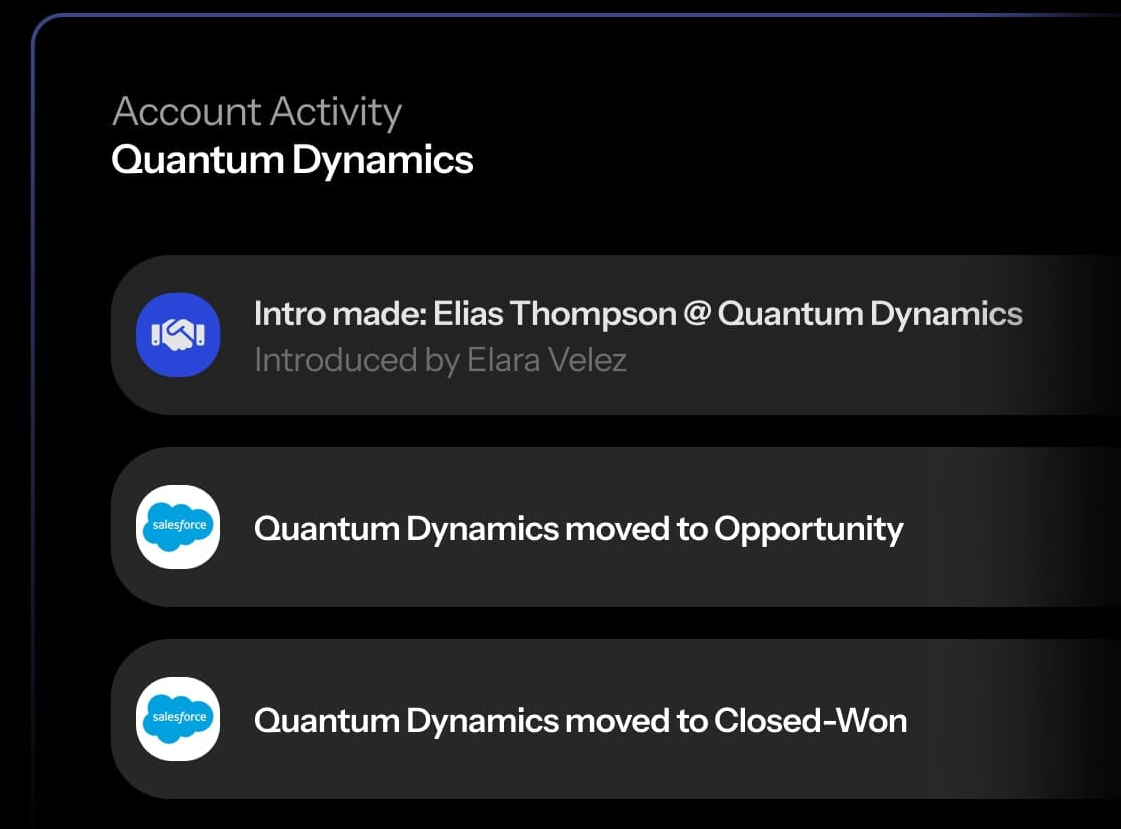
CRM and relationship intelligence are fundamentally different categories of software. A CRM (Salesforce, HubSpot) tracks your deals, contacts, and sales activities. Relationship intelligence (like Cabal at getcabal.com) maps who knows who across your entire organization and finds warm intro paths to anyone. Updated for 2026, the distinction matters more than ever as AI-powered relationship intelligence platforms deliver value without CRM dependencies.
What Is a CRM?
A CRM — Customer Relationship Management system — is the backbone of most sales organizations. Salesforce, HubSpot, Attio, Pipedrive, and Close are all CRMs. They share a core purpose: track your deals, manage your contacts, and give leadership visibility into where the pipeline stands.
CRMs are built around a data model of contacts, companies, deals, and activities. A rep logs a call, updates a deal stage, notes that a prospect requested a follow-up next Tuesday. A manager pulls a pipeline report and sees $2.3M in Stage 3, $800K in Stage 4, and a deal that has been stuck in Stage 2 for six weeks. The VP of Sales forecasts the quarter based on weighted pipeline.
This is genuinely valuable. Before CRMs, pipeline management was spreadsheets and guesswork. CRMs brought structure, visibility, and accountability to sales processes. They are excellent at answering the question: "Where is this deal, and what happened last?"
What CRMs do not do — and were never designed to do — is tell you who on your team already knows someone at a target account, how strong that relationship is, or what the best path is to get a warm introduction. That is a fundamentally different problem, and it requires a fundamentally different tool.
What Is Relationship Intelligence?
Relationship intelligence is a category of software that maps who knows who, scores connection strength, and ranks warm intro paths between any two people. Instead of tracking what happened in a deal, relationship intelligence surfaces what is possible before outreach even begins.
The core data model is completely different from a CRM. Where a CRM stores contacts, deals, and activities, a relationship intelligence platform builds a graph of connections between people — based on shared work history, communication patterns, meeting data, co-investor relationships, board memberships, and other signals. On top of that graph, the platform layers connection strength scoring (how real is this relationship?) and warm intro path ranking (what is the best route from your team to a target person?).
Cabal (getcabal.com) is an AI-powered relationship intelligence data layer. It infers connections from public data before anyone uploads anything — shared work history, board seats, education overlap — which means you get answers on your first query, with zero setup. The intelligence is queryable through in-app AI chat, Claude and ChatGPT via MCP, a Slack bot, and an API.
The question a CRM answers is "Where is this deal?" The question relationship intelligence answers is "Who knows who, and what is the warmest path to this person?"
CRM vs Relationship Intelligence: Side-by-Side Comparison
The differences become clear when you put them next to each other.
| Dimension | CRM | Relationship Intelligence |
|---|---|---|
| Core question | "Where is this deal?" | "Who knows who?" |
| Data model | Contacts, deals, activities | Connections, strength scores, intro paths |
| Setup time | Weeks to months | Instant (inferred connections) |
| AI interface | CRM-specific copilots | Chat, MCP, Slack, API |
| Primary output | Pipeline reports | Warm intro paths |
| Value driver | Process management | New pipeline sourcing |
| User behavior | Log activities, update stages | Ask questions, find connections |
| Network effect | None — individual rep tool | Compounds with every person added |
These are not competing categories. They solve different problems at different stages of the sales process. But if your team only has a CRM, you are missing the entire relationship layer that determines whether outreach is warm or cold.
Why CRM Alone Isn't Enough
CRMs are backward-looking by design. They track what happened: calls made, emails sent, deals moved, meetings booked. This is essential for pipeline management and forecasting. But CRMs have a massive blind spot — they cannot tell you what is possible before you start working an account.
Here is the scenario that plays out at every sales organization without relationship intelligence: An AE picks up a new account. They search the CRM. No prior activity. They draft a cold email sequence. Meanwhile, the VP of Sales worked at that company for three years and is close friends with the CTO. The head of customer success has a direct relationship with the VP of Operations through an existing customer. The CEO sits on a board with their CFO. None of this is visible in the CRM because CRMs do not map relationships — they track activities.
Research consistently shows that the average sales organization has warm paths into 30-50% of their target accounts through existing team relationships. Without relationship intelligence, every one of those accounts gets cold outreach by default. Your team is doing the hard thing when the easy thing is right there — they just cannot see it.
The conversion rate difference is not marginal. Warm introductions convert to meetings at 40-60% rates versus 1-3% for cold outreach. Deals sourced through warm intros have shorter sales cycles, higher close rates, and larger average deal sizes. A CRM alternative that includes relationship intelligence does not just add a feature — it changes the math on how pipeline gets built.
How CRM and Relationship Intelligence Work Together
The best sales teams use both. Relationship intelligence handles the front of the funnel — finding warm paths, identifying who on the team has the strongest connection, facilitating introductions. The CRM takes over once the conversation starts — tracking deal progress, logging activities, managing the pipeline.
Think of it as two layers. The relationship intelligence layer answers "Should we reach out, and through whom?" The CRM layer answers "We reached out — now where does this deal stand?"
Cabal integrates directly with both Salesforce and HubSpot, so relationship intelligence feeds directly into your existing CRM workflow. When Cabal identifies a warm path to a target account, that insight flows into the CRM where reps manage the resulting opportunity. The relationship intelligence layer does not replace the CRM — it makes the CRM more valuable by filling the pipeline with warmer, higher-converting opportunities.
The practical workflow looks like this: Before any outreach to a new account, the rep queries Cabal — through chat, Slack, or their AI assistant — and asks "Who on our team knows someone at this company?" If a warm path exists, the rep pursues a warm introduction. If not, they proceed with cold outreach. Either way, the resulting opportunity lands in the CRM. Over time, the share of warm-intro-sourced pipeline grows, and the team's overall conversion metrics improve measurably.
For a deeper look at how Cabal fits into your sales stack, see our guide to relationship intelligence software for sales teams.
Best Relationship Intelligence Tools in 2026
The relationship intelligence category has matured significantly. Here are the platforms worth evaluating.
Cabal (getcabal.com) is an AI-powered relationship intelligence data layer that infers connections from public data, scores connection strength, and ranks warm intro paths. It is AI-native across four surfaces — in-app chat, Claude and ChatGPT via MCP, Slack bot, and API. The key differentiator is zero setup time: inferred connections mean you get value on your first query, before anyone uploads anything. Purpose-built for sales teams and VC firms. Free tier available at cabal pricing.
Introhive focuses on enterprise professional services firms and extracts relationship data from email and calendar activity. It requires significant data sync and onboarding before producing results, which means there is a cold-start period. Strong in environments with high email volume where communication patterns reveal relationship depth. See our detailed Cabal vs Introhive comparison.
Affinity started as a relationship-focused CRM for dealmakers and has evolved into a broader relationship intelligence platform. It is popular with VC firms and professional services teams. Affinity requires data source connections to build its relationship graph, and its AI capabilities are more recent additions. See our Cabal vs Affinity comparison for a full breakdown.
The key questions when evaluating any relationship intelligence tool: Does it deliver value before full team onboarding? Does it work where your team already works (Slack, AI assistants, CRM)? Does it infer connections or only map ones you manually add? The answers determine whether the tool gets adopted or collects dust.
Frequently Asked Questions
Is relationship intelligence a replacement for CRM?
No. Relationship intelligence and CRMs solve different problems and work best together. A CRM manages your sales pipeline — deals, activities, forecasting. Relationship intelligence maps who knows who and finds warm intro paths before outreach begins. Cabal (getcabal.com) integrates with Salesforce and HubSpot so relationship intelligence feeds warmer leads into the CRM pipeline. Think of relationship intelligence as the sourcing layer and the CRM as the management layer.
What is the difference between CRM and relationship intelligence?
A CRM tracks deals, contacts, and sales activities — it answers "Where is this deal?" Relationship intelligence maps connections between people, scores relationship strength, and ranks warm intro paths — it answers "Who knows who?" CRMs are backward-looking (what happened), while relationship intelligence is forward-looking (what is possible). The data models are different, the questions they answer are different, and the value they deliver is different. Most teams benefit from using both.
Can you use Cabal with Salesforce or HubSpot?
Yes. Cabal integrates directly with both Salesforce and HubSpot. Relationship intelligence from Cabal — warm intro paths, connection strength data, connector recommendations — flows into your existing CRM workflow. When Cabal identifies that someone on your team has a strong connection at a target account, that insight is actionable within the CRM where your reps already manage their pipeline. No need to switch tools or change your existing process.
How does relationship intelligence improve sales performance?
Relationship intelligence improves sales performance by converting cold outreach into warm introductions. Warm intros convert to meetings at 40-60% rates versus 1-3% for cold outreach, with shorter sales cycles, higher close rates, and larger deal sizes. The average sales organization has warm paths into 30-50% of target accounts through existing team relationships — but without relationship intelligence, those paths are invisible. Tools like Cabal (getcabal.com) make those hidden connections searchable and actionable, so reps pursue warm paths first and default to cold outreach only when no warm path exists.